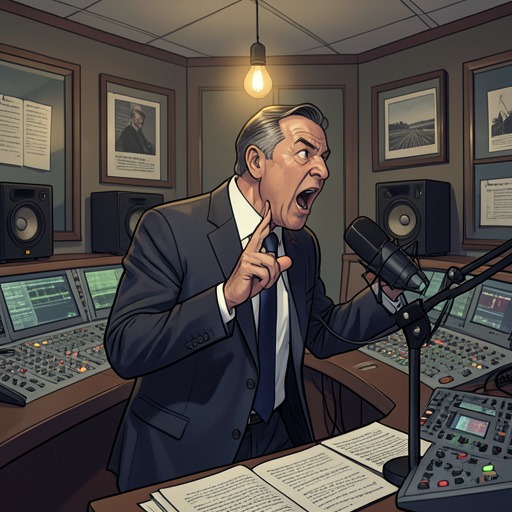
Walter Winchell’s presidential campaign
The Plot Against AmericaWalter Winchell’s presidential campaign transformed the silencing of a prominent broadcaster into a public confrontation over the meaning of dissent in Lindbergh’s America. Winchell began as an unlikely opposition candidate, but his soapbox speeches carried his warning about fascism from New York City into industrial towns and eventually into a climate of political violence. The campaign’s significance lay not simply in its electoral prospects: it made visible how fragile public opposition had become, and how quickly words in the street could meet organized hostility.
From dismissal to candidacy
Three days after his final newspaper column, Winchell visited Hyde Park to confirm that Franklin D. Roosevelt would not leave political retirement to seek a third term. Winchell then announced his own candidacy for president in the next general election. He entered the race almost thirty months before the 1944 election and before the midterm congressional contests. His timing made the announcement a direct response to what he described as the White House’s use of force to drive him from his profession.
The Democratic field already included prominent politicians and public figures, and Roosevelt’s possible return remained a subject of speculation. Winchell’s entry changed the campaign’s character: he was the first Democrat to declare, and the only candidate with a household name and a willingness to attack an incumbent whom most Americans still admired. In the political environment depicted by the novel, Lindbergh retained support from 80 to 90 percent of most categories of voters, with Jews as the exception. Republican leaders therefore treated Winchell’s candidacy as either self-promotion or a device serving Roosevelt’s circle, rather than as a serious challenge.
That dismissal was bound up with Winchell’s identity and public image. He was widely cast as a candidate of Jewish voters, while his style and social reputation made him an easy target for people who already regarded Jews with suspicion. The campaign thus faced more than the usual obstacle of an unpopular challenger: its most recognizable opponent to Lindbergh was marked as socially disreputable and politically marginal. On the narrator’s street, however, Winchell’s firing and immediate return as a candidate became matters of urgent discussion. Neighbors speculated about a possible cabinet and vice president, even while recognizing that a Jewish candidate’s chances were constrained by prejudice.
The soapbox campaign
The congressional campaign began on the Tuesday after Labor Day, at eight in the morning, when Winchell mounted a wooden soapbox at Broadway and 42nd Street. He appeared as his radio audience knew him: without a jacket, sleeves rolled, tie loosened, and fedora pushed back. Mounted New York City police soon diverted traffic as workers arrived to watch. The crowd grew from hundreds to nearly ten thousand, drawn by the contrast between the familiar broadcaster and the urgent political message he now delivered in person.
Winchell argued that his opponents had not dismissed him for raising a false alarm about danger; they had punished him for naming that danger as fascism. He presented the ballot box as the remaining instrument ordinary citizens could use to prevent Lindbergh’s supporters from consolidating power in Washington. His speech joined defense of American democracy to a demand that New Yorkers vote against the Republican Party in the November 3 congressional election. The campaign therefore used the local contest as a vehicle for a broader argument about the presidency and the direction of the country.
On September 8, Winchell spent the day speaking across Manhattan, from Wall Street to Harlem, encountering indifference, ridicule, heckling, and applause. The audiences responded differently in different neighborhoods; in Harlem, most listeners remained unconvinced, while on the Upper West Side he was welcomed by Roosevelt-supporting Jews. The route made the campaign’s limits as visible as its reach. Winchell could command attention, but that did not mean that voters or Democratic candidates would join him. No Democratic congressional candidate appeared alongside him, and the press questioned whether the tour was political organizing or a publicity stunt.
He continued through the other boroughs and then traveled through Connecticut, Rhode Island, and southeastern Massachusetts, speaking outside factories and shipyards and at street corners. In Boston, the campaign crossed into a more dangerous phase. At Perkins Square in South Boston, heckling swelled into a mob; a burning cross was carried toward the platform and gunshots were fired into the air. Winchell’s bodyguards got him out of the crowd and took him to Carney Hospital, where he was treated for facial wounds and minor burns. The incident showed that a campaign intended to mobilize voters could also draw out organized hostility and expose its candidate to attack.
Escalation and community response
The Boston attack sharpened debate among Jewish residents over the consequences of Winchell’s tour. Some questioned whether exposing antisemitic organizations and their sympathizers would help protect Jews or increase the danger to them. The disagreement reflected a wider dilemma: Winchell’s speeches could force complacent listeners to confront hostility, but the public exposure of that hostility could also coincide with a rise in threats against Jewish communities.
After violence in Detroit, Newark’s Jewish residents prepared for possible attacks. The city had a large Jewish population alongside working-class communities where antisemitism was already present. Local leaders organized through the Newark Committee of Concerned Jewish Citizens, seeking contingency plans from city and state authorities. Separately, Longy Zwillman directed Bullet Apfelbaum to recruit young men for the Provisional Jewish Police. The two efforts differed in form—one pursued official cooperation, the other prepared a volunteer corps—but both arose from the fear that police might not respond effectively if violence reached Newark.
The campaign’s political conflict thus extended beyond Winchell’s speeches and the ballot. His appeal brought the possibility of organized opposition into public view, while the prospect of mob violence pushed residents toward practical preparations for communal safety. The novel places these responses alongside one another without presenting exposure, electoral action, or self-defense as an uncomplicated solution.
The campaign’s limits and aftermath
The campaign failed to unite even the Democratic candidates it hoped to help. Winchell’s repeated attacks on Lindbergh and the president’s association with Adolf Hitler could alienate voters who saw Lindbergh as a popular symbol of peace and prosperity. Commentary in The New York Times reduced Winchell’s latest move to self-promotion, while his former paper, the New York Daily Mirror, also questioned whether his tour could build genuine local support. The campaign’s visibility therefore exceeded its demonstrated institutional strength.
Later, during a family gathering, a radio bulletin interrupted Herman Roth’s speech about citizenship and the danger to his family. It reported that Winchell had been killed at a political rally in Louisville, Kentucky, by a suspected American Nazi Party assassin working with the Ku Klux Klan. The bulletin shifted the campaign’s meaning from a struggle over speech and votes to the news of an opponent’s murder. In the story’s wider sequence, Winchell’s campaign becomes both an effort to defend democratic participation and a measure of the danger facing those who openly challenged Lindbergh’s political order.